Line Stopping
Line stopping gives you a temporary isolation inside a live pipeline so work can be done downstream while the rest of the system stays in service. Also called line plugging, it means no drain down, no loss of product, and no shutting the system off.
Call 1800 468 827 with your pipe size, material and what’s in the line, and we’ll tell you which method suits the job.
What is line stopping?
A stop is inserted into the live line through a fitting, blocking the bore and holding back the pressure while you cut, weld, replace a valve or tie in a new section. When the work is finished the stop is withdrawn and the line goes back to normal service.
It is a temporary isolation, which is the main thing that separates it from a hot tap. A hot tap leaves a permanent valved connection behind. A line stop leaves the pipe as it was.
Hot tapping or line stopping: which do you need?
They are usually not alternatives. They are two halves of the same job.
A hot tap creates access into a live line. A line stop creates isolation, and it is normally performed through a hot tap fitting, so the tap comes first and the stop goes in through it. If all you need is a new branch or a valved connection, a hot tap on its own is enough. If you need the flow held back so a section can be opened up, you need the stop as well.
Where a mechanical stop will not work, pipe freezing (including in Adelaide) gives you the same isolation with nothing welded onto the pipe at all. If you describe the job to us we will tell you which of the three we would use and why.
What methods do you use?
Australian Hot Taps offers a range of line stopping and plugging options. Hot tapping and inserting rubber stops or live bag insertions. Squash offs with or without encasements. And the EZ2 stopping system.
The EZ2 has largely obsoleted traditional stopping and drain downs in the water market, and we see that as the future for regaining control of live operating systems. Our development work is focused on replicating the EZ2 process and its benefits on the pipe types and sizes it does not yet cover.
Can you line stop a water main?
Yes. Flow can be stopped on most services. On steel water mains from 100mm to 300mm we can insert a valve into the live line with the EZ2 system, which leaves you with a permanent isolation point rather than a temporary one. Where the EZ2 cannot be used we can offer balloon or bag off isolation instead.
What pipe materials can be stopped?
We work on steel, stainless, copper, PVC, HDPE, PE, cast iron, ductile iron, cast and ductile cement lined, AC and most other pipeline materials, carrying natural gas, coke gas, chilled water, heating hot water, potable water, condenser water, steam, compressed air, chemical, petrochemical and various waste product lines.
Every pipeline gets ultrasonic NDT wall thickness testing before we weld or tap it. If it’s too thin to weld on, we’ll tell you before we start.
A live diversion in Caboolture
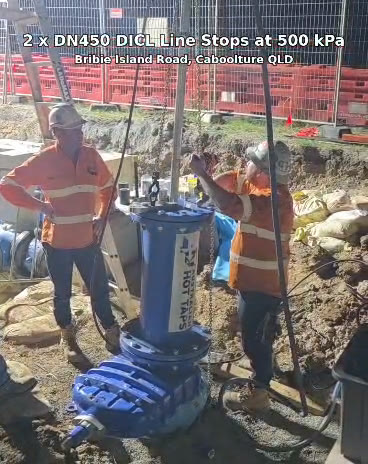
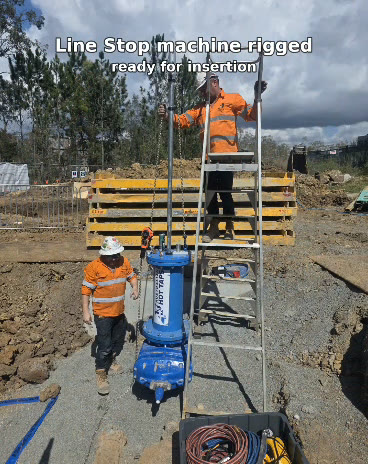
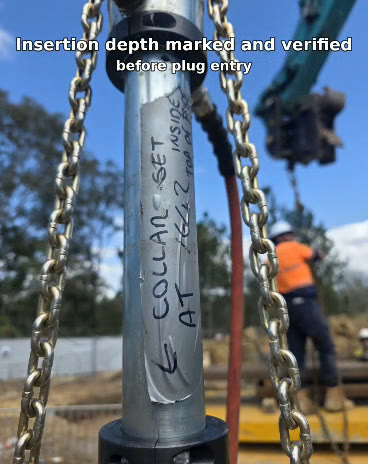
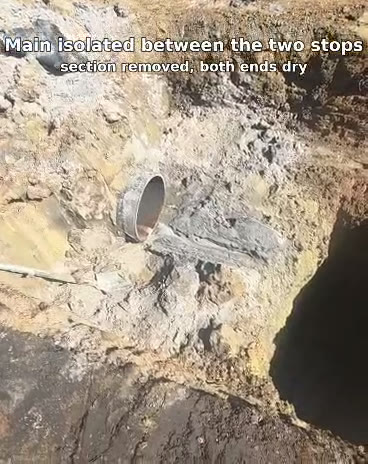
This is what two line stops actually looked like on a recent job: a DN450 water main on Bribie Island Road, Caboolture, diverted live at 500 kPa. The network never came out of service.
What helps us quote it
How long the isolation has to hold, and what is downstream of it, move a line stop price most. The rest helps:
- Pipe size and material
- What’s in the line, and at what pressure
- Whether you need a temporary stop or a permanent valve
- How long the isolation needs to hold
- How you get to the pipe. Above ground, in a riser, or buried and needing an excavation
- Any drawings or photos
Call 1800 468 827 or email [email protected]. If you’re not sure which method your line needs, just give us a call, we’ll ask a few questions and let you know.
Where we work
We operate from depots in Bayswater, Victoria and Currumbin Waters, Queensland, and we have clients in all states and territories of Australia as well as the Pacific Islands and New Zealand. We regularly fly in and out to service our clients.
Most of our stopping work is around the two depots, in Melbourne and on the Gold Coast, though we travel for it. The Bribie Island Road job above was on Brisbane’s northern edge. Brisbane and south east Queensland and Gippsland and eastern Victoria are the two we are asked about often enough to have written up on their own.
Line stopping is one of ten live pipeline services we provide. We also offer hot tapping, pipe freezing, squash offs, live valve insertion, live gas diversions, leak repair and testing and purging.
Our line stopping options

Australian Hot Taps has been connecting into live pipelines since 1996, and in 1998 became the first company accredited by the Office of Gas Safety, now Energy Safe Victoria, to hot tap live gas lines. Hot tapping, line stopping, pipe freezing and live valve insertion on gas, water, steam and process lines, Australia wide.